Factory-Direct OEM/ODM · Onsite-verified by TÜV Rheinland · 12 Years in Power Strip Manufacturing
0%

Wholesale buyers evaluating China’s USB C Power Strip manufacturers need more than a polished product photo. They need clear answers about port output, total wattage, plug options, materials, production capacity, and quality checks. A USB-C port can look identical across two models while delivering very different performance. Details matter.

USB-IF President Jeff Ravencraft has emphasized that USB Type-C describes a connector, not every capability it supports. A practical paraphrase of his point is: “Check the power specifications, not just the USB-C shape.” Buyers should request test reports, confirm how power is shared when several devices charge, and compare samples under realistic use. A phone, laptop, and tablet on one strip can reveal limits that a specification sheet may not make obvious.

This guide introduces manufacturers and offers a framework for comparing them. It considers product range, customization, communication, sample quality, and order consistency—not just quoted price. Ask how factories handle inspection records and changes between sample approval and mass production. Small differences in cable length, socket spacing, or labeling can matter in a crowded retail box. No supplier scorecard is perfect. And a low price is not proof of value. Buyers should verify claims directly, keep written specifications, and leave room for a second round of questions. That extra effort can feel tedious, but it is often where better sourcing decisions begin.
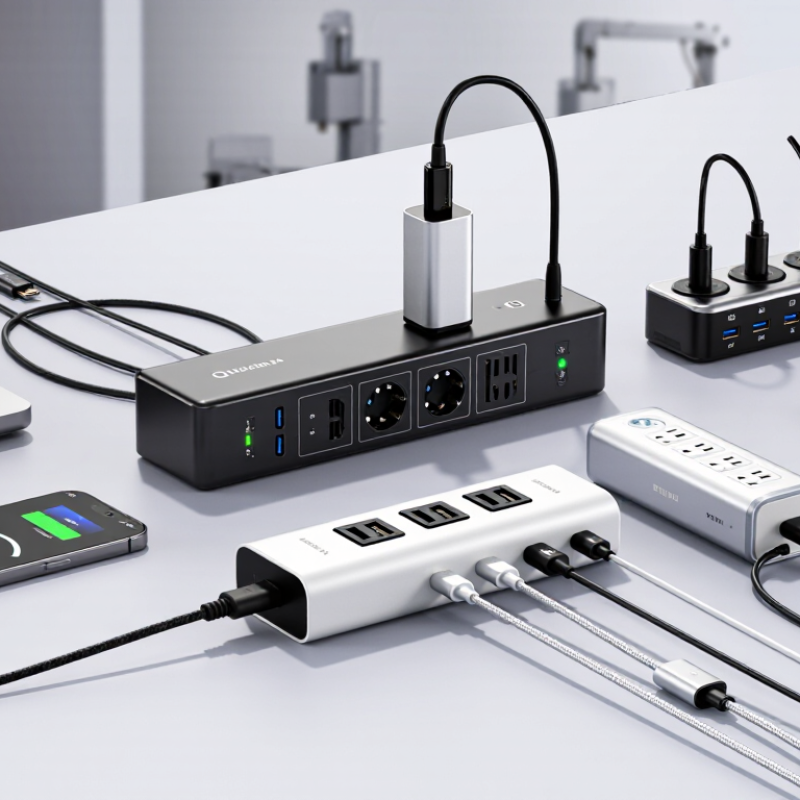
China Top USB C Power Strip Manufacturers for Wholesale Buyers

Classify USB-C Power Strips by Ports and USB PD 3.1’s 240 W EPR Ceiling

For wholesale buyers, classify USB-C power strips by usable port count: two-port models suit bedside charging, three- or four-port units fit shared desks, and higher-count designs serve meeting rooms. More ports aren’t always better. Check whether ports share one power budget or deliver stated outputs independently. A label promising 100 W per port may not mean every port can supply 100 W at once.

USB Power Delivery 3.1 raises the Extended Power Range ceiling to 240 W, according to the USB Implementers Forum’s May 2021 specification announcement. EPR adds 28 V, 36 V, and 48 V profiles, alongside a 5 A limit. That ceiling describes the protocol’s maximum—not a typical strip output. A 240 W-capable port also needs a compatible charger design, cable, and device; shared-load controls can reduce output when several devices connect. Real-world sharing is messier. Buyers should compare the total USB output, per-port ratings, and AC outlet capacity separately.

Tips: Match port count to actual devices, then inspect the power-sharing table. Look for explicit EPR support and a rated 5 A cable for 240 W use. Check the fine print. Product sheets sometimes emphasize peak output while leaving simultaneous charging less clear.

USB-C Power Strip Reference: Port Counts and USB PD 3.1 Power

Port-count classes are commonly described as 1, 2, 3–4, or 5+ USB-C ports. Port count is a configuration category, not a power rating.

USB PD 3.1 SPR supports up to 100 W. EPR adds 28 V, 36 V, and 48 V profiles, reaching a maximum of 240 W at 48 V and 5 A. Actual output depends on the power strip, connected device, and a compatible 5 A EPR-rated cable.

Match Output Claims to USB-C Cable Ratings: 3 A Standard and 5 A E-Marked

For wholesale buyers comparing USB-C power strips made in China, the printed wattage is only half the story. A port may advertise 100 W, but the cable can limit usable power. The USB-IF USB Type-C Cable and Connector Specification sets 3 A as the standard cable-current rating; cables rated for 5 A require electronic marking. At 20 V, that means up to 60 W versus 100 W, subject to device negotiation and power-strip limits. Small label. Big difference.

When reviewing supplier claims, ask for cable and port test results under load. The USB Power Delivery specification defines negotiated power profiles, so a 5 A cable alone cannot make a port deliver 100 W. Check that the cable’s E-Marker identifies its 5 A capability, and confirm the strip sustains the stated output when other ports are occupied. Request test details for voltage, current, cable length, and simultaneous charging. I would treat a polished brochure as a starting point, not proof; test conditions can differ, and that detail is easy to overlook.

Check China Mains Compatibility at 220 V/50 Hz and Socket Configurations

For wholesale buyers, a USB-C power strip’s mains rating matters as much as its port count. China’s supply is commonly specified as 220 V at 50 Hz, but confirm the exact input range printed on each product and its packaging. A wide-range rating may suit more installations, yet it does not replace checking the intended market’s electrical requirements. Ask the manufacturer for a current specification sheet and a production sample. Read the label carefully.

Socket layout needs equal attention. China commonly uses Type A and Type I-style outlets, and some products combine more than one socket format. Check the socket drawings against the plugs your customers actually use, including grounded plugs and larger adapters. Look at spacing: a bulky charger can block the neighboring outlet. Small detail, big impact. Also confirm USB-C output ratings, total shared power, and whether port performance changes when several devices charge together.

Before approving a wholesale order, inspect samples for firm socket grip, clear markings, and stable fit with representative plugs. Request photos of the internal rating label, but do not rely on photos alone. A datasheet can miss a small mismatch. We would still test a physical unit under realistic use, then compare the findings with the final order specification.

China Top USB C Power Strip Manufacturers for Wholesale Buyers - Check China Mains Compatibility at 220 V/50 Hz and Socket Configurations
Specification Mainland China Reference Wholesale Buyer Checks
Nominal mains supply 220 V AC, 50 Hz Confirm the power strip’s input rating covers the intended supply and is shown on the product label and technical documentation.
Common Chinese socket configuration Type I-style outlets are commonly used. Two-pin and three-pin versions are available, depending on the product design. Specify the required outlet type and number. Check that plug dimensions, earthing arrangements, and outlet spacing match the intended use.
10 A socket outlets Chinese household socket systems include 10 A configurations, commonly rated up to 250 V. Check the strip’s total current rating, the rating of each outlet, and the rating of the supplied cord and plug. Do not assume every outlet can carry the strip’s full rated load simultaneously.
16 A socket outlets 16 A configurations are used for higher-current applications and are not interchangeable with standard 10 A plugs and outlets. Confirm that the plug, cord, outlets, protective components, and intended circuit are all suitable for the specified current.
Mixed outlet configurations Products may combine multiple AC outlets with one or more USB charging ports; outlet counts and layouts vary by model. Request a dimensioned layout drawing. Check plug clearance, spacing for larger adapters, earthing, and whether the requested configuration is available for the target order.
USB-C connector and charging protocol A USB-C receptacle describes the connector shape; it does not, by itself, confirm USB Power Delivery (USB PD) support. Ask for the supported charging protocols and USB-C output profiles. Verify the stated performance through a product specification sheet and sample testing.
USB-C output power Available output voltage, current, and power depend on the specific charging circuitry and product design. Confirm maximum output per USB-C port and the combined output when multiple ports are used at the same time. Check whether power is shared between ports.
Combined AC and USB loading The power strip’s overall limit is determined by its rated mains current and design, not by the number of outlets or USB ports alone. Request the total-load rating and any stated limits for simultaneous AC and USB use. Ensure labels and instructions clearly describe overload precautions.
Protection and construction Features such as overload protection, surge protection, shutters, and indicators are product-specific; they should not be inferred from appearance. Ask which protections are fitted, what their ratings are, and which test reports support the claims. Review enclosure, cord, plug, and temperature test details.
Compliance and destination market Applicable certification and safety requirements depend on the product category and the country where it will be sold. For mainland China sales, verify whether CCC certification applies to the exact product. For exports, check the destination market’s requirements and request documentation for the exact model.
Wholesale sample verification Electrical ratings, port behavior, and socket fit should be checked on the production-representative model. Test a sample at the intended 220 V/50 Hz supply, confirm outlet and plug fit, check USB-C charging behavior under simultaneous loads, and compare the sample label with the approved specification.
Configuration planning Outlet count, USB-C port count, cord length, switch arrangement, and enclosure design are order-specific product choices. Put the complete configuration, electrical ratings, labeling, packaging, and approved test documents into the purchase specification before production.
Ratings and configurations vary by product. Confirm all values against the exact model’s label, instructions, and test documentation before ordering.

Verify CCC Certification and GB 2099.7 Extension-Set Safety Requirements

For wholesale buyers, CCC verification should start with the certificate’s product scope, model, and manufacturer—not a logo on the carton. Confirm the certificate through China’s official certification records, then match it against the nameplate and test report. Check that the applicable GB 2099.7 edition covers the extension-set configuration being sold. Small details matter. Rated current, cord cross-section, plug dimensions, earthing, and strain relief should match the submitted sample. A changed cable or enclosure can make an old report a poor fit.

The safety case is practical, not just paperwork. NFPA’s Home Electrical Fires report, covering 2015–2019, estimated an annual average of 46,700 U.S. home fires involving electrical failure or malfunction, with about 390 civilian deaths. These figures are not specific to extension sets or China, but they show why component and assembly checks deserve attention. Ask for evidence of temperature-rise, insulation, mechanical-strength, and cord-anchorage testing under the relevant requirements. Inspect a production sample, including the plug pins and cable entry. A tidy sample can still hide batch variation. I would also compare the certificate holder, factory address, and actual production site; buyers sometimes skip that step.

Compare Wholesale Manufacturers by MOQ, OEM Options, and Batch-Test Reports

For wholesale buyers, MOQ is only useful when the supplier defines what it covers. Ask whether the quoted minimum applies to standard units, custom packaging, or a fully customized USB-C power strip. A 500-unit MOQ may sound manageable, yet separate packaging and tooling minimums can raise the first order substantially. Request a pilot batch and confirm the price breaks before approving artwork.

OEM comparisons should get specific. Check plug type, outlet spacing, USB-C port count, power-delivery profiles, cable length, and labeling. Ask for a pre-production sample that matches the proposed materials and internal layout. Small details matter: a bulky adapter can block an adjacent socket. Paper specifications can miss that.

Batch-test records help buyers assess consistency, not just claims. Request reports tied to a lot number, with sample size, test date, and measured results for grounding, insulation, temperature rise, and USB-C output under load. NFPA’s Home Electrical Fires report estimated 46,700 U.S. home electrical fires annually from 2015 to 2019, causing 390 civilian deaths each year. This is broad electrical-fire data, not a power-strip failure rate, but it underlines why traceable checks matter. Ask whether testing is performed in-house or by an independent laboratory, and request an example report before placing a bulk order. Some buyers accept a PDF too quickly. Read the actual measurements.

FAQS

What mains rating should buyers check for China?

China’s supply is commonly specified as 220 V at 50 Hz. Confirm the product’s exact input range on its label and packaging. Read the label carefully.

Which socket layouts should a USB-C power strip support?

China commonly uses Type A and Type I-style outlets. Compare socket drawings with customers’ actual plugs, including grounded plugs and larger adapters. Fit matters.

How can buyers check whether outlets are spaced well?

Test the strip with bulky chargers and representative plugs. Make sure one adapter does not block a neighboring outlet. Small detail, big impact.

What USB-C details belong in the product specification?

Check each port’s output rating, total shared power, and power-delivery profiles. Ask whether performance changes when several devices charge together. It can.

What should a pre-production sample reveal?

Inspect socket grip, markings, and plug stability. Request a sample with the proposed materials and internal layout. Photos help, but they are not enough.

What should buyers clarify about MOQ and customization?

Ask whether the minimum covers standard units, custom packaging, or full customization. Separate tooling or packaging minimums may raise the first order. Easy to miss.

What details make a batch-test report useful?

Look for the lot number, sample size, test date, and measured results. Reports may cover grounding, insulation, temperature rise, and USB-C output under load.

Should buyers accept a PDF test report without review?

Ask whether testing was in-house or independent, and request an example report. Read the actual measurements. A PDF can look reassuring, yet still leave questions.

Conclusion

Choosing a USB C Power Strip for wholesale requires more than counting outlets. Buyers should compare the number and type of USB-C ports, then distinguish shared power from per-port output. USB PD 3.1 can support up to 240 W under its Extended Power Range specification, but the strip’s stated capacity, device requirements, and included cables must all align. Standard USB-C cables are generally rated for up to 3 A, while higher-current 5 A charging requires a properly rated, electronically marked cable.

For products intended for China, confirm compatibility with 220 V/50 Hz mains and the socket configuration required by the target market. Check applicable CCC certification and GB 2099.7 safety requirements for extension sets, and request supporting documentation rather than relying only on product claims. When comparing manufacturers, assess minimum order quantities, OEM and customization options, production consistency, and batch-test reports. These checks help wholesale buyers evaluate both technical fit and supplier reliability before placing an order.

Ethan

Ethan

Ethan is a professional marketing specialist with a strong understanding of the company’s products, customers, and industry. He combines product knowledge with a clear, practical approach to communication, helping readers understand how different solutions work and how to choose options that suit......